
The History of the Bristol Mint is a chronicle of power, rebellion, and economic survival, stretching from the reign of Saxon kings to the chaotic frontlines of the English Civil War. For any history enthusiast visiting the city, understanding the legacy of Bristol’s coinage offers a unique window into how this port city shaped the very wealth of the nation. While the physical structures of these early financial hubs have largely vanished, the silver remnants of their industry tell a story of a settlement that grew into one of the most significant provincial centers in Western Europe.
The Saxon Origins: Bristol Silver Pennies 11th Century
The appearance of Bristol silver pennies 11th century marked the official entry of the town into the documented history of the English realm. Before the city was mentioned in the Anglo-Saxon Chronicle or the Domesday Book, its status was confirmed by the silver pennies bearing the mint signature “BRIC” or “BRIG.” This numismatic evidence proves that by the reign of Aethelred II (Aethelred the Unready – poorly advised), around 1009–1010, Bristol had achieved the legal status of a “port” or fortified market town. What a twist and most dark irony of early medieval history. While the rest of Anglo-Saxon England was being systematically bled dry by Viking extortion, Bristol was actively getting rich off the Vikings’ own supply chains. Viking armies raided eastern England and forced King Æthelred II to pay them astronomical sums of silver (the Danegeld), which got traded back into England via Bristol.
According to the laws of King Athelstan, the right to strike coins was strictly reserved for such locations, ensuring that the king could maintain control over the quality and taxation of currency. The confluence of The River Avon and River Frome proved an excellent strategic location. Saxon Lords could easily tax boats passing by at this meeting point.
King Cnut: The Bristol Mint History Reveals A Period Of Significant Expansion
During king Cnut’s reign (1016–1035), the output of the local mint increased dramatically. Many of these coins have been recovered from Viking hoards in Scandinavia, suggesting that Bristol-made silver was used to pay the Danegeld or to facilitate the burgeoning sea trade with Dublin and the North. The Anglo-Saxon moneyers Bristol employed, such as Aegelwine and Godwin, were high-status individuals who held personal responsibility for the weight and purity of the silver. If a moneyer was found to have issued debased currency, the penalties were severe, often involving the loss of a hand.
As the Norman Conquest approached, the mint continued to operate under Harold II and subsequently William the Conqueror. The recent discovery of the Chew Valley Hoard, containing over 2,000 coins, provides a vivid snapshot of this era. It includes coins from the Bristol mint that were struck during the very years of the transition from Saxon to Norman rule, demonstrating that the financial infrastructure of the city remained resilient despite the political upheaval. These coins are the primary reason historians can confidently date the urban development of Bristol to the early 11th century.
- Earliest Minting: c. 1009–1010, Reign of Aethelred II.
- Location: Likely near the original Saxon bridge or high ground of the Old City.
- Key Moneyers: Aegelwine, Godwin, and Aelfwine.
- Venue for Viewing: Bristol Museum & Art Gallery, Queen’s Road, Bristol BS8 1RL. Coins, artifacts from local archaeological exploration and documentary evidence.
Medieval Might: Minting At Bristol Castle
The medieval period saw the minting process move within the formidable defenses of Bristol Castle to ensure the security of the kingdom’s bullion. As the fortress became one of the most important royal strongholds in the west of England, the mint evolved from a collection of individual moneyers into a more centralised royal institution. During the 12th and 13th centuries, the castle was not just a military garrison but a financial hub where silver from across the region was consolidated and struck into the currency of the realm.
During the civil war known as The Anarchy (1135–1153), Bristol served as the headquarters for Empress Matilda and her half-brother, Robert, Earl of Gloucester. Because they were in open rebellion against King Stephen, they required their own currency to pay soldiers and assert their legitimacy. The Bristol mint produced unique coins for Matilda, some of which bore her title as “Imperatrix.” This rebel coinage is a rare example of a provincial mint operating in direct opposition to the reigning monarch, highlighting the strategic importance of Bristol’s wealth during national crises.
By the time of the Edwardian reforms in the late 13th century, the minting process became even more standardised. Edward I introduced the “long cross” penny to discourage clipping, and the Bristol mint was one of the few provincial locations authorized to assist with this massive national recoinage. The “BRISTOW” mark became a symbol of quality and consistency. The minting rooms within the castle walls would have been scenes of intense heat and labor, with smiths forging dies and laborers manually hammering out thousands of coins daily to satisfy the Crown’s appetite for funding Welsh and Scottish campaigns.
- Operational Peak: 12th and 13th Centuries.
- Location: Bristol Castle (Eastern end of current Castle Park), Bristol BS1 3XB.
- Historical Event: Production of Empress Matilda’s rebel coinage during The Anarchy.
- Key Figures: Robert, Earl of Gloucester and King Edward I.
The Great Debasement And Scandal: 1546–1549
In 1546, during the latter years of Henry VIII’s reign, the Bristol Mint was reactivated not to produce sound money, but to facilitate one of the most destructive economic policies in English history: the Great Debasement. The Crown needed to liquidate confiscated monastic wealth to fund foreign wars, and Bristol was the only provincial mint authorized to strike both gold and silver outside of Southwark. However, the operation quickly devolved into a hub of unprecedented corruption under the newly appointed Under-Treasurer, Sir William Sharington.
Sharington weaponized the minting process for personal enrichment and political intrigue. He secretly clipped silver from coins, kept operations off the official ledgers, and struck over 100,000 unauthorized pieces. Furthermore, Bristol’s geographic position made it the ideal staging ground for exporting this hyperinflation. The mint systematically struck heavily debased silver and copper-alloy coins specifically designated for Ireland, deliberately devastating the Irish economy to subsidize English state debts.
The illicit profits generated in Bristol did not just line Sharington’s pockets; they were actively used to bankroll high treason. Sharington funneled his stolen wealth to Thomas Seymour, the Lord High Admiral, who was plotting an armed rebellion against his own brother, the Lord Protector of the young King Edward VI. When the plot was exposed and collapsed in 1549, Seymour was executed. Sharington narrowly escaped the executioner’s block, but the scandal forced the immediate closure of the Bristol Mint, ending a brief but catastrophic chapter in the city’s financial history.
- Dates of Operation: 1546–1549, Reigns of Henry VIII and Edward VI.
- Location: Bristol Castle.
- Key Figures: Sir William Sharington (Under-Treasurer) and Thomas Seymour.
- Historical Impact: The Great Debasement, funding of treason, and economic destabilization of Ireland.
Royalist Rebellion: Bristol Mint Charles I Silver Coins
The production of Bristol mint Charles I silver coins represents one of the most dramatic episodes in the city’s long history. Following the capture of Bristol by Royalist forces in 1643, the city became the most important minting center for the King outside of Oxford. Thomas Bushell, a flamboyant entrepreneur and mining engineer, was appointed to oversee the operations. He moved his equipment and workmen to the city to ensure that the Royalist army had a steady supply of high-quality silver to fund the ongoing Civil War against Parliamentary forces.
The Civil War coinage Bristol mint produced is renowned for its distinctive artistry and political messaging. The most famous issues are the “Declaration” coins, which featured an inscription on the reverse declaring the King’s commitment to the Protestant religion, the laws of England, and the liberty of Parliament. This was a sophisticated piece of silver-stamped propaganda, intended to reassure the public of the King’s intentions even as the nation was torn apart by conflict. These coins, ranging from massive silver pounds to small groats, were often struck using silver plate donated by loyalist families and Oxford colleges.
Collectors and historians today identify these pieces by the distinctive “BR” monogram or a simple “B” mark. The mint was situated within the castle and later possibly at other secure locations within the city walls to protect it from Parliamentary bombardment. When Bristol was finally surrendered by Prince Rupert in 1645, the minting equipment was seized or dismantled, marking the end of the Royalist financial machine in the west. These silver coins remain some of the most sought-after artifacts of the English Civil War, representing the final era of hammered coinage in the city.
- Royalist Occupation: 1643–1645.
- Primary Official: Thomas Bushell, Warden of the Mint.
- Location: Bristol Castle and various fortified sites in the Old City.
- Signature Mark: “BR” monogram or “B” mint mark.
The Final Chapter: The Great Recoinage Bristol 1696
The Great Recoinage Bristol 1696 was the final significant act in the city’s numismatic history. By the late 17th century, the national currency was in a state of ruin. Most silver coins in circulation were old, worn, and frequently “clipped”—a practice where the edges were shaved off for their silver content. To solve this, the government of William III ordered that all hammered money be withdrawn and replaced with new, machine-milled coins with reeded edges that made clipping impossible. Bristol was chosen as one of five provincial cities to host a temporary mint to expedite this massive transition.
The mint was established at St Peter’s Hospital Bristol, a grand timber-framed building that had previously served as a sugar refinery. This facility was equipped with modern horse-drawn mills and screw presses, moving away from the ancient method of hand-hammering. The operation was vast; between 1696 and 1698, the Bristol site processed nearly £450,000 of silver. The work was grueling, involving the melting down of thousands of pounds of old coin and casting them into new ingots before they were rolled and punched into blanks for the presses.
Coins from this final period are marked with a small letter “B” under the King’s bust to denote their Bristol origin. Despite the efficiency of the operation, the provincial mints were always intended to be temporary. Once the bulk of the nation’s currency had been replaced, the Bristol mint was decommissioned in 1698. The building at St Peter’s Hospital eventually transitioned into a workhouse and later an administrative building for the Bristol Board of Guardians. Though the building was destroyed during the 1940 Blitz, the silver coins produced there continue to circulate in the collections of historians as the last legacy of Bristol’s minting power.
- Dates of Operation: September 1696 – September 1698.
- Location: St Peter’s Hospital (formerly Peter Street), Bristol.
- Total Output: Approx. £440,225 in silver coin. What’s that worth today? If you simply look at the cost of goods and services (using the Retail Price Index and historical inflation data), £450,000 in 1698 would be worth approximately £110 million to £125 million today. Another way to look at it, in 1698, a skilled laborer earned about £15–£20 a year. This sum represented the annual wages of over 25,000 workers.
- Current Site: The ruins of St Peter’s Church in Castle Park mark the approximate location.
The story of the Bristol Mint is more than just a tale of old coins; it is the story of Bristol’s rise from a Saxon bridge-settlement to a pivotal player in the English Civil War and the global economy. Though the hammers have long fallen silent at St Peter’s Hospital and Bristol Castle, the silver legacy of the city remains tucked away in museum cabinets and private collections, a permanent record of the city’s ancient importance. On your next tour of the Old City, take a moment to stand near the ruins of St Peter’s and imagine the heat of the furnaces and the clatter of the presses that once defined this historic quarter.
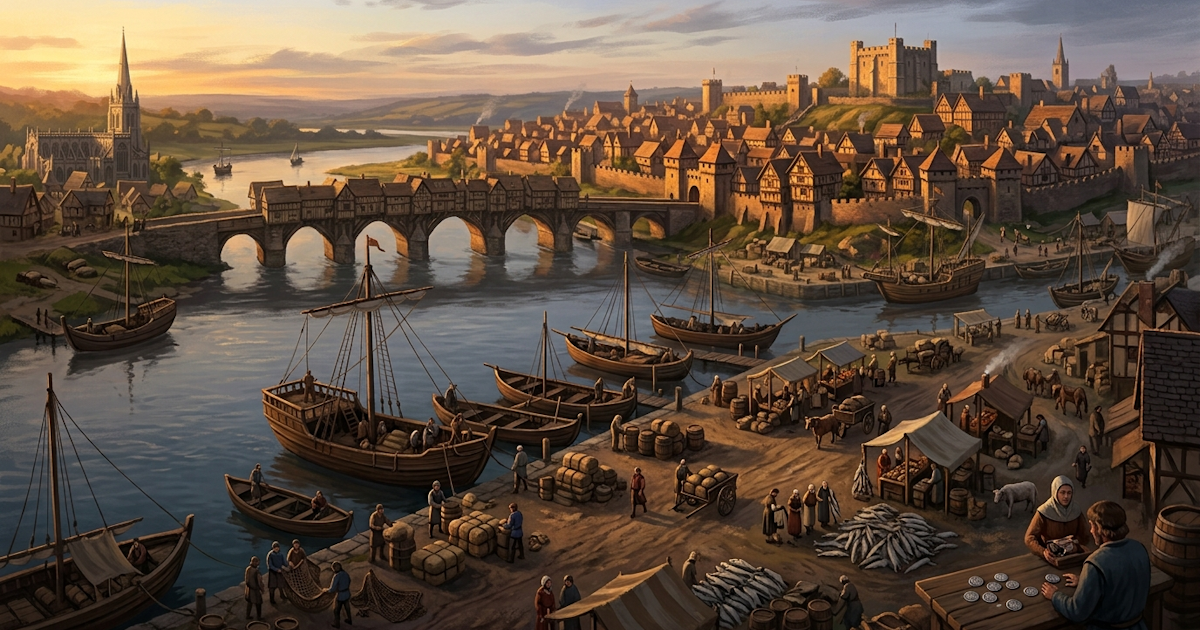
Bristol’s Origin Story
This concise history of Bristol explores how the city evolved from a strategic river crossing into a global maritime powerhouse and modern tech hub. By linking its geography to its industrial ambition, we can see how the “Place by the Bridge” shaped the world. From here you can link to explore certain aspects of Bristol’s […]

From Atlantis, to Bristol to the United States of America
Bristol played a vital role in the network of events that link the ancient world to what became the United States of America and Canada. The Platonic ideals and the Atlantis myth provide the “intellectual spark” that eventually found its way into the maritime and colonial ambitions of Bristol. Plato’s writings, specifically the dialogues Timaeus […]

Bristol Historical Firsts: A Legacy Of Industrial And Cultural Innovation
Bristol Historical Firsts represent a legacy of restless ambition and engineering prowess that has defined this inland southwestern port city for centuries. This location has served as a crucible for ideas that changed the trajectory of global history, from the methods used to navigate the oceans to the very foundations of modern international commerce. Maritime […]