
Bristol played a vital role in the network of events that link the ancient world to what became the United States of America and Canada.
The Platonic ideals and the Atlantis myth provide the “intellectual spark” that eventually found its way into the maritime and colonial ambitions of Bristol. Plato’s writings, specifically the dialogues Timaeus and Critias, use the Atlantis myth to explore the concept of the Ideal State, a theme that resonates through the history of Bristol’s development and its influence on the New World.
The Atlantis Myth as a Political Blueprint
Plato did not present Atlantis merely as a legend, but as a cautionary tale to contrast with his “Ideal Athens.” The core of how this influenced later statecraft involves several key themes:
- The Ordered State vs. The Imperial Power: Plato described his ideal Athens as a perfectly ordered, self-sufficient society governed by reason. In contrast, Atlantis began as a noble society but became corrupted by wealth and a “lust for power,” leading to its destruction.
- The Design of Society: The myth introduced the revolutionary idea that a state could be “designed” rather than simply evolving through tribal or royal tradition. This concept of a planned, rational society is a cornerstone of Platonic ideals.
- Western Expansion: Atlantis was described as a massive island “beyond the Pillars of Hercules” (the Strait of Gibraltar). For centuries, this idea planted a seed in the Western mind that a vast, lost, or “new” world existed to the West, waiting to be rediscovered or rebuilt according to ideal principles.
Transmission To Bristol: Intellectual And Moral Capital
The influence of these classical ideals reached Bristol through a long intellectual chain, primarily facilitated by the Church and the Roman legacy:
- Roman Infrastructure of Ideas: The Romans, who left a lasting mark on the Bristol region, brought with them structured ideas on trade, law, civil engineering, and how to organise things and people. After the fall of Rome, Roman influence continued through the Holy Roman Empire which was intertwined with the catholic church.
- The Church as a Custodian: During the Middle Ages, the Catholic Church preserved classical knowledge, including Platonic thought. Bristol became a breeding ground for wealth and intellectual capital facilitated by religion, providing the moral authority to pursue large-scale societal projects. St Mary Redcliffe Church, a catholic church for hundreds of years, was central to this connection.
- The “Venture” Philosophy: Bristol’s development was characterized by a “bottom-up” approach to power. When Bristolians financed and dug the “Great Ditch” in 1240 to create a new harbor, they were applying a rational, collective design to their city, independent of royal decree.
Architecting the New World
This combination of Platonic idealism and Bristolian practicality directly shaped the colonization of North America: starting with exploration.
John Cabot was the physical pioneer who acted on the westward myth helping turn it into a geographic reality for the English Crown.
Setting sail from Bristol in 1497 aboard the Matthew, Cabot was not merely seeking a trade route to Asia; he was the first European since the Vikings to strike the North American mainland, effectively breaking the psychological barrier of the “Pillars of Hercules.” By planting the Venetian and English banners in Newfoundland, he provided a foundation, the legal and territorial claim, upon which many subsequent “Ideal State” designs were built. His voyage proved that the vast Western land described in ancient lore actually existed, transforming the Atlantic from a terrifying void into a bridge for the migration of Bristol’s maritime and social ambitions.
The Theoretical Architect: Richard Hakluyt
The geographer and senior Bristol Cathedral clergymen acted as the intellectual bridge. He used his “intelligence” gathered from Bristol sailors to argue for a “designed” colonial project that would solve England’s social problems—a practical application of building an ideal society in a “New World”.
Ideas first made public in 1584 in his manuscript Discourse of Western Planting. Social unrest at the time was perceived to be due to overpopulation of what Hakluyt called “valiant youths” and “idle persons.” These were men displaced by the enclosure of farmlands who had turned to petty crime or vagrancy, due to the long-term economic fallout of the Tudor Debasement. During the debasement, the collapsed value of the English Pound temporarily made English wool exports incredibly cheap and highly profitable on the European market. This artificial export boom heavily incentivized landlords to accelerate the “enclosure” process—evicting tenant farmers to convert arable crop land into lucrative sheep pastures, which required vastly less human labor to maintain. These men needed something to do and something to build.
Later Hakluyt becomes the primary advisor to the “Merchant Venturers” of Bristol, framing their commercial voyages as a national and spiritual destiny. Combined with his other books; Divers Voyages Touching the Discovery of America and The Principal Navigations, the stage is set for future events.
The Philosophical Blueprint; Sir Francis Bacon
Francis Bacon began to contemplate the higher purpose of these voyages. He reimagined Plato’s Atlantis not as a lost tragedy, but as a future opportunity for a scientific and rational society. In 1605 Bacon publishes The Advancement of Learning. He begins to argue that the “New World” isn’t just a place to find gold, but a laboratory for a new kind of human society based on science and reason.
The New Atlantis was Bason’s posthumous publication: a work that served as the installation manual for new ideas acting as an evolution of some of the old classical ways of things from Athens and Rome.
The “New World” as an Empirical (data) Laboratory. Bacon’s philosophy was built on Empiricism: the idea that truth is found through observation and experiment rather than sitting in a library.
In his utopian work The New Atlantis, Bacon described a fictional island called Bensalem. Unlike European nations that evolved through centuries of tribal conflict and monarchical tradition, Bensalem was a designed society governed by reason and scientific pursuit.
Bacon argued for the “Great Instauration”—a total reboot of human knowledge. He believed the “Old World” was trapped by “Idols of the Theatre” (ancient, unproven dogmas). He proposed that truth must be found through empiricism: observation, measurement, and data.
Bacon famously argued that the goal of knowledge was not just abstract contemplation but the “relief of man’s estate”—improving the human condition through technology and industry.
In Bacon’s ideal world, the most important institution was Solomon’s House, a college of “Merchants of Light” who were judged on their discoveries and contributions rather than their noble birth.
These ideas guide Bacon through his restructuring of the Virginia Company. This struggling speculative venture was given corporate sovereignty. It moved power away from the King and into the hands of the “Adventurers” (investors). Through its ‘joint stock’ innovation it allowed for a massive influx of capital by selling shares to anyone—not just aristocrats. This turned the colonization of America into a public-private partnership. The company was incorporated as “The Treasurer and Company of Adventurers and Planters of the City of London for the First Colony in Virginia.” The Planters were also given a stake in the new world. Not being able to provide finance (as investors) they provided labour. Bristol was the primary source for the “Planters”—the blacksmiths, shipwrights, and carpenters needed to build the physical structures of the “Ideal State.”
Jamestown was founded by the Virginia Company in 1607 in honour of King James I granted royal Charter to this colonisation. A charter designed by Francis Bacon.
Profit From Seasonal Fishing Turned Into Permanent Settlement
While early explorers sought gold, Bristol merchants like John Guy focused on “trade ideals and steady profit”. John Guy was a Bristol merchant, Sheriff, and eventually the Mayor of Bristol. He represents the first moment the “New Atlantis” idea became a physical settlement. Guy treated his 1610 Newfoundland colony like a “new branch of a business,” bringing skilled tradesmen to build a functioning, permanent society from the ground up.
Sir Francis Bacon was actually a founding member and a major investor in the London and Bristol Company (also known as the Newfoundland Company) that funded John Guy’s voyage. Bacon wasn’t just writing about a utopian island in his study; he was putting his own money into John Guy’s ships to see if that “Ideal State” could actually be built on the shores of the New World.
John Guy’s instructions for the colony were incredibly detailed, focusing on law, order, and the systematic extraction of resources—a practical application of the “Ordered State” Plato described in his dialogues.
The Seed Of Independence
The Bristolian principle shaped in part by the philosophy of Bacon showcased that “control should be owned by those with skin in the game” rather than a distant monarch mirroring the Platonic idea of a state governed by those most invested in its rational success. This mindset laid the foundations for the later push for American independence.
In essence, the Atlantis myth provided the geographical and imaginative spark, Plato provided the intellectual framework for an ideal society, and Bristol provided the maritime hardware and merchant labour to try and build that ideal in the modern world.
Bristol’s historical trajectory provides a compelling narrative of how a strategic river crossing transformed into a global powerhouse that fundamentally influenced the founding of the modern United States and Canada.
The “Bristol Footprint”
This legacy is visible today in the names of American cities like Bristol in Rhode Island, Pennsylvania, and Virginia, as well as in the timber-framing architecture of early New England houses, which mirrored the medieval streets of Bristol. Not to mention Bristol Bay in Alaska, coined by the explorer Captain James Cook during his voyage through the area in 1778 in honour of the Admiral Earl of Bristol.
What else?
Attributing the Atlantis myth to ancient Greek philosophy does acknowledge the diverse network of events that came before. The origins of Bristol’s involvement in this story stretch back much further to Ancient Egypt. The narrative begins with the transmission of esoteric knowledge from Ancient Egypt to the Greek world, involving Egypt, Solon and Plato.
- The Egyptian Connection: According to Plato’s dialogues (Timaeus and Critias), the Athenian statesman Solon traveled to Egypt (specifically the city of Sais) in the 6th century BC. There, he was told by Egyptian priests of a lost civilization; Atlantis, and a primeval Athens that embodied perfect social order.
- Plato’s Ideal State: Plato used these accounts to develop his theories on the Ideal State. He envisioned a society governed not by hereditary monarchs or chaotic mobs, but by “philosopher-kings” and rational structures. This introduced the foundational Western idea that a state should be a designed, intellectual project rather than a collection of tribal territories.
This intellectual lineage—from the priests of Sais to Solon’s laws, Plato’s Republic, and finally the Merchant Venturers of Bristol—represents the journey of the idea that a “New World” could be intentionally designed and governed.
Another Founding Father With Links To Bristol
William Penn had a profound connection to Bristol; his wife, Hannah Callowhill, was from a prominent Bristol merchant family, and he spent significant time in the city, which served as a major departure point for many Quakers traveling to the new colony of Pennsylvania.
William Penn’s ability to read and write in Latin was a direct result of the “intellectual capital” that had been preserved in Western education since the Roman era. Fluency in Latin allowed him to read the original works of Plato and other classical philosophers without translation.
Penn acted as the ultimate “architect” of a modern state when he drafted the Frame of Government of Pennsylvania (1682) written in Bristol. This document was heavily influenced by the lineage of ideas described here.
In this sense, William Penn was the bridge that carried the ancient wisdom of the Mediterranean, refined through the mercantile and religious filter of Bristol, into the physical and legal architecture of the United States.
Pennsylvania (Penn’s Woods) was named after his father Admiral Sir William Penn and given to his son William Penn as payment of a debt owed by King Charles II to the Admiral. Admiral Penn’s memorial inside St Mary Redcliffe Church is quite distinctive. It features his armor—including his helmet and breastplate—and the tattered banners of Dutch ships he captured in battle.
John Locke Ran With Sir Francis Bacon’s Philosophical Ideas And Worked Them Into His Own Political And Legal Blueprints
John Locke (1632 – 1704) lived close to Bristol and had business interests in the city which linked him to the City’s Merchant classes. Known as the father of liberalism and a foundational figure of the English Enlightenment profoundly shaped modern western political philosophy and democratic governance. His influence on the merchant venturers in Bristol as well as London have shaped the formation of how North America operates today. Locke spent time in Holland and integrated into the intellectual and political circles surrounding William of Orange. Locke supported William’s invasion of England to become king (glorious revolution) and was the premier intellectual defender of the new regime. Capital and ideas from Holland followed King William III to England: and the Bank of England was established as a private joint stock company with Royal Charter in 1694. This paved the way for fractional reserve banking and the creation of credit to serve the interests of the state. Ideas that were exported west to the colonies.
Locke famously argued that property rights are established when a person “mixes their labor” with the land. This provided the perfect legal and moral justification for English colonization, validating the ownership claims of the investors and masters who funded the settlements while delegitimizing the rights of indigenous populations.
Locke was far from a detached, abstract philosopher; he was deeply involved in the bureaucratic governance of these new territories as Secretary to the Lords Proprietors of Carolina and later as a prominent commissioner on King William III’s Board of Trade. In these roles, he structured the governance of the American colonies to maximize corporate and investor profit.
While he wrote passionately about liberty, Locke’s actions and legal contributions aligned completely with the commercial interests of slave-trading ports. He helped draft the Fundamental Constitutions of Carolina, a document that explicitly codified chattel slavery, and he was a major shareholder in the Royal African Company. Ultimately, Locke provided the “legal software”—balancing property rights for the elite with the subjugation of bound labor—that allowed the commercial empire built by Bristol’s Merchant Venturers to flourish legally and financially.
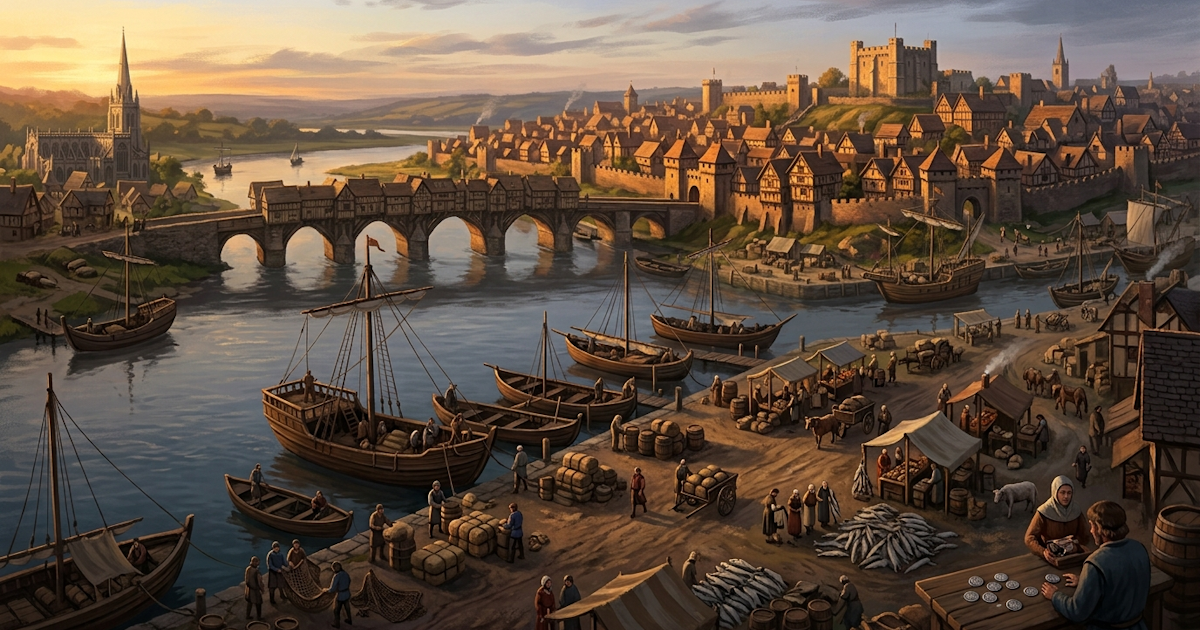
Bristol’s Origin Story
This concise history of Bristol explores how the city evolved from a strategic river crossing into a global maritime powerhouse and modern tech hub. By linking its geography to its industrial ambition, we can see how the “Place by the Bridge” shaped the world. From here you can link to explore certain aspects of Bristol’s […]
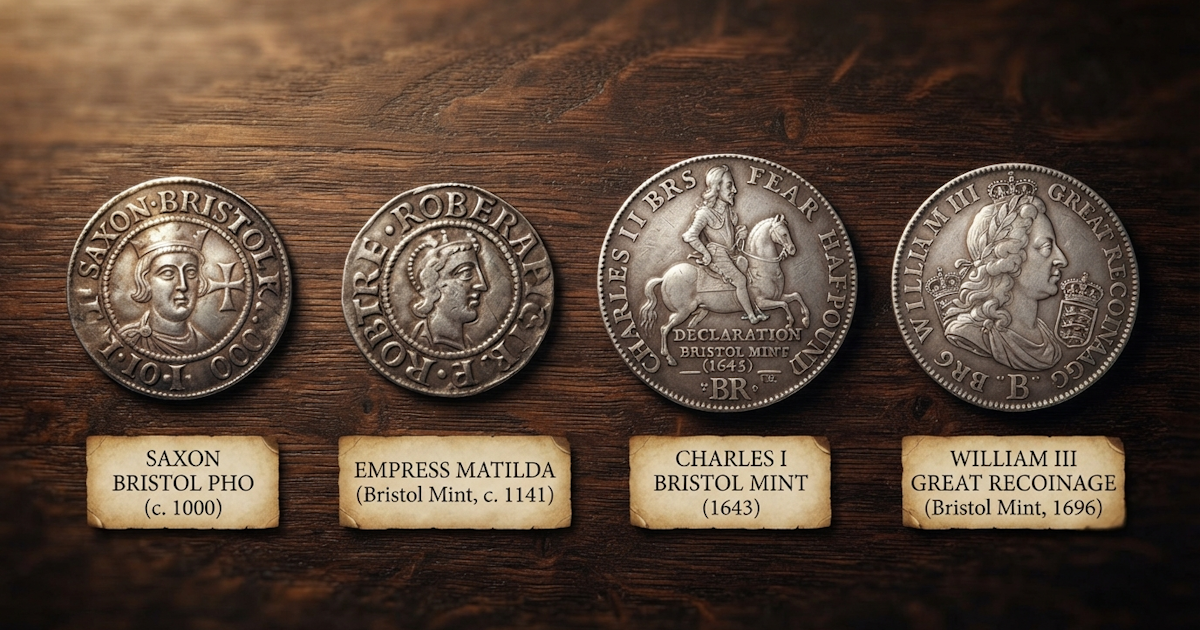
History Of The Bristol Mint
The History of the Bristol Mint is a chronicle of power, rebellion, and economic survival, stretching from the reign of Saxon kings to the chaotic frontlines of the English Civil War. For any history enthusiast visiting the city, understanding the legacy of Bristol’s coinage offers a unique window into how this port city shaped the […]
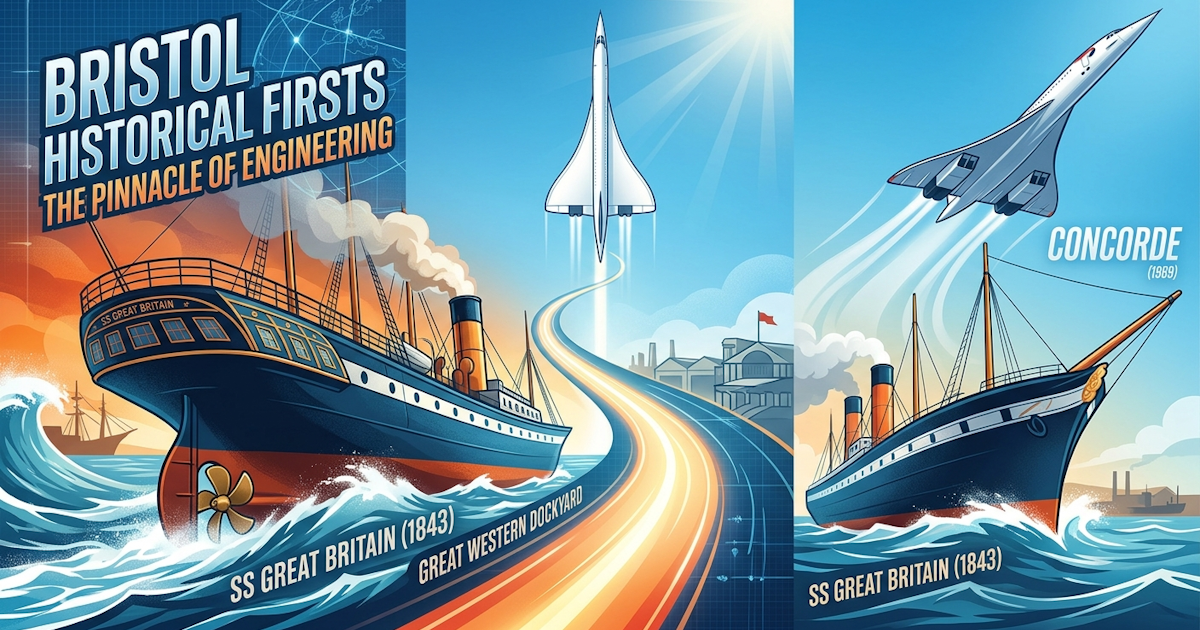
Bristol Historical Firsts: A Legacy Of Industrial And Cultural Innovation
Bristol Historical Firsts represent a legacy of restless ambition and engineering prowess that has defined this inland southwestern port city for centuries. This location has served as a crucible for ideas that changed the trajectory of global history, from the methods used to navigate the oceans to the very foundations of modern international commerce. Maritime […]