Visitors exploring the urban landscape will quickly discover that Bristol city centre public works of art provide a fascinating visual history of this historic port. From traditional bronze statues commemorating maritime pioneers to avant-garde contemporary sculptures and world-famous street murals, the city serves as an accessible open-air gallery. Walking through these public squares allows travellers to engage with local heritage without spending a penny, making it an ideal destination for anyone seeking budget-friendly walking tours in Bristol. The deliberate curation of these spaces ensures that creativity remains woven into daily civic life, inviting onlookers to pause and contemplate the stories behind the stone, metal, and paint.
Finding Masterpieces via a Free Bristol Sculpture Trail Guide
Navigating the diverse array of Bristol city centre public works of art is made simple if you use this free Bristol sculpture trail guide. Ensures you do not miss hidden artistic gems tucked away in historic alleyways and quiet courtyards. While many visitors arrive searching exclusively for an affordable street art tour in Bristol options often overlook these magnificent physical monuments. By focusing on permanent dimensional pieces, travellers gain a deeper appreciation for how the physical environment reflects centuries of local growth and civic pride.
The Legacy of John Cabot at Narrow Quay
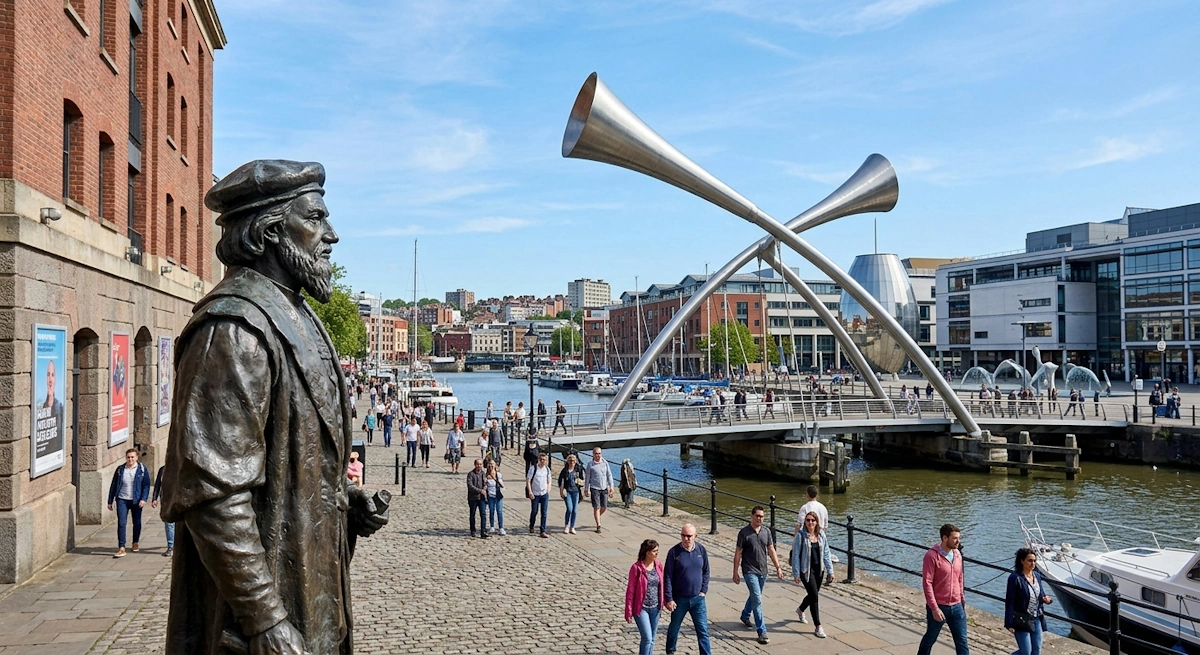
Located outside the Arnolfini Arts Centre, the bronze statue of John Cabot stands as a monument to international exploration. Sculpted by Stephen Joyce in 1986, this figure commemorates the historic moment in 1495 when Cabot arrived in the city from Venice before setting sail to discover Newfoundland. The placement on the cobblestones allows visitors to walk directly up to the sculpture, creating an intimate connection between modern spectators and the maritime past. The detailing of his attire and his determined gaze toward the water evoke the adventurous spirit that defined the era. It remains a key focal point for historical interest and a highly recommended stop on any self-guided tour.
The Matthew noramlly located accross Prince Street Bridge at Princes Wharf is arguably another public work of art that may be attractive to those visiting Bristol. Originally this caravel (a small, fast 15th-century sailing ship developed by the Portuguese) was built for John Cabot for his famous voyage west. When naval architect Colin Mudie designed this modern replica in the 1990s, he closely recreated a 15th-century caravel to match historical records and customs accounts that described the original ship as a navicula (little ship) of 50 tons burden.
Crossing the Horns of Pero’s Bridge
Just a short walk up Narrow Quay leads to Pero’s Bridge, an architectural marvel designed by Eilis O’Connell and opened in 1998. This bascule bridge is instantly recognizable by its distinct pair of horn-shaped counterweights made of stainless steel. Beyond its striking visual form, the bridge holds deep historical significance, named in honour of Pero Jones, an enslaved African man who lived and worked in the city during the eighteenth century. The structure acts as both a physical link across the water and a symbolic monument to a dark chapter in global trade. Walking across its spans offers beautiful views of the floating harbour while prompting reflection on the individuals who shaped the local economy.
- Location: Narrow Quay and Pero’s Bridge
- Address: City Centre, Bristol, BS1 4QA
- Dates: Permanent public installations open daily
Exploring Harbourside Public Statues in Bristol city cente and Millennium Square
The massive urban rejuvenation project around Millennium Square highlights how modern architecture can seamlessly integrate creative expressions. This specific district shows how space can be converted from industrial maritime docks into a celebrated public sphere dedicated to education, science, and the arts. Visitors exploring Bristol City Centre may like to make note of these Harbourside public statues to elevate how you experience what Bristol has to offer.
Water and Form at Millennium Square
Millennium Square represents one of the largest public art commissions in the South West region, featuring an expansive collection of works embedded into its open spaces. A dominant feature is Aquarena, a spectacular series of water sculptures designed by William Pye that animates the plaza with movement and sound, making this a top Millennium Square water sculptures venue. These unique water installations can be drained when necessary to transform the area into a distinctive performance venue. Nearby, Zenith by David Ward uses lighting across the square to create shifting visual dynamics after dark, ensuring the space remains engaging at all hours. This thoughtful integration of elements makes the square a premier destination for families and art enthusiasts looking for an interactive experience.
The Animal Instincts of Nicola Hicks
Tucked within the same public precinct, visitors can encounter a large-scale bronze sculpture titled Beetle, created by the renowned artist Nicola Hicks. This imposing yet tactile piece contrasts beautifully with the sleek, modern lines of the surrounding science museum and theatre. Alongside this insectiod marvel, the square features smaller painted bronze sculptures of animals by Cathie Pilkington, adding a sense of playfulness to the concrete landscape. For those interested in human figures, the figurative bronzes by Lawrence Holofcener depict notable historical communicators, bridging the gap between natural history and human achievement. These works encourage close inspection and provide excellent photographic opportunities for tourists.
- Location: Millennium Square
- Address: Canons Way, Bristol, BS1 5DB
- Dates: Sculptures accessible year-round
Discovering Top-Rated Castle Park Public Art and Hidden Urban Curiosities
Many of the finest examples of Bristol city centre public works of art reside within green spaces, where top-rated Castle Park public art provides a quiet retreat from the busy shopping districts. This expansive riverside park contains a diverse collection of post-war and contemporary installations that reward slow exploration, making this one of the best public artwork trails Bristol has to offer. Armed with an iconic city centre Bristol art map, you can track down these individual pieces while enjoying the natural scenery along the Avon.
The Granite Whispers of Peter Randall-Page
Nestled amid the lawns and historic ruins of the park, Beside the Still Waters by Peter Randall-Page offers a serene combination of sculpture and water. Carved from solid granite, these tactile pieces invite touch and provide a calming focal point near the water’s edge. This installation is complemented nearby by Ann Christopher’s Line from Within, a dramatic four-and-a-half-metre-high abstract bronze sculpture cast at the famous Pangolin Foundry. These abstract forms contrast with the historic remnants of St Peter’s Church, creating a space where modern creativity honours the layers of history buried beneath the turf.
The Modern Legend of the Bristol Crocodile
For a touch of contemporary local humour, visitors should look closely at the river banks to find the Bristol Crocodile. This whimsical sculpture, created in 2024 by the anonymous artist collective Getting Up To Stuff, is fashioned from plaster, cement, and resins. It sits snugly in a cubbyhole just above the water level, referencing a popular local legend about a bus driver who claimed to have spotted a real crocodile swimming in the river. This playful addition demonstrates that the local public art scene is far from static, continuously evolving with new, unexpected contributions that delight both locals and sharp-eyed tourists.
- Location: Castle Park Riverside
- Address: Broad Weir, Bristol, BS1 3XB
- Dates: Crocodile installed September 2024; other works permanent
Historic Bristol Monuments City Centre and Legacy Sculptures
Bristol’s public works of art are commonplace in the civic open and green spaces. These grand structures offer a stark contrast to nearby street art, representing the formal artistic tastes of the Victorian and Edwardian eras. Understanding these monuments helps visitors chart the shifting aesthetic values of the city as it evolved from an imperial trading hub into a modern cultural capital.
Queen Victoria on College Green
Standing proudly on the northern side of the great gatehouse, the marble and bronze monument to Queen Victoria is a premier example of late-nineteenth-century civic sculpture. Designed by Joseph Edgar Boehm and unveiled in 1888, the statue features intricate relief panels on its granite pedestal that depict significant events and themes from her reign. Positioned on the open lawns of College Green, it faces the magnificent cathedral, serving as a landmark for political rallies, community gatherings, and tourist photographs. The formal execution of the marble figure highlights the traditional craftsmanship that dominated public spaces before the advent of abstract modernism.
Broadmead and the Spirit of Bristol
Moving toward the commercial shopping districts, the public art takes on a distinctly mid-century and modern aesthetic. On Bond Street, the massive stainless steel sculpture titled Spirit of Bristol by Paul Mount stands over five metres high on a substantial pedestal. Erected in 1971, its sweeping metallic curves mirror the post-war architectural regeneration of the Broadmead area. Further into the pedestrian zones, installations like the Spirit of the Trees by Wolfgang Buttress add organic textures to the retail environment, proving that artistic expressions are vital in softening the hard surfaces of busy commercial blocks.
- Location College Green and Broadmead Pedestrian Zone
- Address: College Green, Bristol, BS1 5UY
- Dates: Queen Victoria statue unveiled 1888; Spirit of Bristol erected 1971
Concluding your journey through the rich landscape of public installations leaves a lasting impression of a city that values creativity in all its forms. From the monumental historical figures to the playful contemporary interventions along the waterways, these pieces enrich the environment and offer a free, educational narrative for every traveller. This free Bristol Sculpture Trail Guide provides a map and descriptions (on click will download the trail). Planning a multi-day visit ensures you have ample time to discover every hidden carving, modern sculpture, and historic plaque across the city centre.