Bristol’s origins are early Medievil, not Roman, but she rests at the centre of a trifecta of Roman Sites creating an opportunity for Roman history enthusiasts. From Bristol it is easy to reach Bath Roman Spa (Aquae Sulis) and temple, Caerleon Romam Fortress (Isca Augusta) and Chedworth Roman Villa. When planning an itinerary to uncover ancient history, visiting the finest Roman historical sites near Bristol offers an exceptional gateway into Britain’s Roman imperial past. Exploring these locations reveals the sophisticated engineering and cultural transformations brought by the Roman occupation, giving visitors a tangible connection to the ancient world without needing to travel far. Taking these affordable Roman history days out allows for a deep dive into antiquity, perfect for those seeking educational and engaging experiences. From the military might displayed in Wales to the thermal waters of Somerset and the opulent country estates of the Cotswolds, the region holds some of the most significant archaeological treasures in the United Kingdom. Explored in connection with one another they are an unbeatable example of how Roman Britain operated. Representing three pillars of the Roman occupation of Britain, namely, civic integration, millitary force and agricultural wealth.
Bath’s origin story
Briton was civilised by Roman occupation. In all honesty it can not be denied. Emperor Claudius created the province of Britannia after Aulus Plautius lead four legions (and auxilliary soldiers) comprising 40,000 troops. Enough to establish settlements and begin integrating with the locals. A settlement was established shortlly after discovering that the local Celtric tribe (the Dobunni) worshipped the hot springs at the site of modern day Bath. Located on the river Avon it made sense, the River provides access outwards towards the Severn Estuary and inwards into the hinterland. No body understood the importance of integrating with local people better than the Romans. Doing so by respecting local religious practices and customers was key. The Dobunni associated the hot springs with healing and spiritual awakenings through the worship of Sulis, a Celtic Goddess. By calling it Aquae Sulis (The Waters of Sulis) they united Celtic and Roman into one place name and merged Sulis with Minerva. What was known to the local Britains simply as sacred hot springs (which cold heal) now became the beggings of an impressice bathing and temple complex. Where romanised Britons could worship Sulis Minerva. At the time the deity Minerva was marketed by the Romans to represent strategic victory, discipline, and calculated warfare. A perfect companion for the healing powers of Sulis.
Aquae Sulis was connected to Isca Augusta by The Via Julia (The Julian Way) named after the Julian clan of Julius Ceasar fame. Various evidene shows both sites where intertwinned. Sea Mills Bristol was once The Port of Abona and literally formed the end of the Road for the English side of the route. Legionaires and wealthy citizens would have travelled over the Severn Estuary regularly for health and relaxation at the spa resort of Aquae Sulils. Romans and the Celtic tribes revered hot springs due to the health benefits brough about due to the minerals in the water (water travels through deep underground limestone aquifers before bubbling up to the surface bring minerals with it) and the physical therapy induced by hot water. As well as healing though the power of the mind channeled and ligitimised by the divine.
After Roman military presence in Britain disipated Aquae Sulis was left to ruin. Similarlly with Isca Augusta and eventually at the Villa in Chedworth. An excellent way to get a feel for find Aquae Sulis 200 hundred years or so later is to read the poem The Ruin. A serious poem that laments and wonders at the loss of this once great place, written in Old English, found in a 10th-centuary manuscript called the Exeter Book. Naturally you wouldn’t want to read it in Old English and translations vary. Experts agree it is highly likely to be about Aquae Sulis modern day Bath. In one translation that retains the alliterative verse form famously begins; The wall-stone is wondrous, weathered by fate; The fortresses have crumbled, the creations of giants rot. Roofs have collapsed, the columns in ruins. The storm defense agape and stripped, perished, Age has devoured it. It continues (translation by Seren Morgan-Roberts, polyphonyjournal.com). Anglo Saxons built using wood. To find this once great place must have been emotional and something out of reach for the native population who lacked the architectural and engineering knowledge of the Romans.
Holding the frontier at Cearleon
Unlike other Celtic tribes like The Durotriges (modern Devon and Cornwall) who provided serious resistance and suffered the consequences, The Dobunni of North Somerset, Bristol, and Gloucestershire may have invited the Romans. As reward they inegrated into Roman ways of being, became peaceful and the region became famous for luxurious Roman country villas and the leisure town that turned into modern day Bath. Pushing North-Westwards subduing the locals became more difficult as the land transitioned from quality arable lowlands of South Wales to more mountainous Mid and North Wales. Caerleon Roman Fortress was established about 30 years after the birth of Aquae Sulis to hold the frontier.
The Second Augustan Legion was stationed at Caerleon. Known as Isca Augusta taking it’s name from the nearby River Usk. Caerleon served as one of the most important military sites in Britain, housing the Second Augustan Legion for over two hundred years. This site provides an unparalleled look into the daily lives of soldiers stationed on the western fringes of the empire. The scale of the barracks provides a stark understanding of the formidable Roman military machine and the logistical prowess required to maintain such an outpost. As Roman central command in Britain was having little success with the waring tribes of modern Wales (The Ordovices and others) up to 5500 citizen infantry foot soldiers remained at Isca Augusta to hold the region (against The Silures tribe). A a staging post for further advancement along the Northern edge of the Severn Estuary, and to repel attacks from the mountains.
A vast grid of streets, grand administrative buildings, and even a large-scale hospital was required. As was common with major military installations, a civilian settlement known as a canabae quickly sprang up around the fortress walls. Merchants, tradespeople, families of soldiers, and craftsmen migrated to the area to capitalize on the economic boom generated by 5,000 salaried legionaries. They mass-produced a specific type of red-slipped pottery known today as “Caerleon Ware,” which imitated the high-quality Samian ware imported from the continent. The legions also laid down a sophisticated network of roads connecting Isca to other outposts and civilian centres across the province. Visiting Cearleon today you will feel the heritage of local craftsmanship showcased at Ffwrwm Arts and Crafts Centre (don’t worry I can’t pronounce it either). Find the open air gallery in a walled courtyard gaden with pieces, masterfully carved out of solid tree trunks and roots by sculptor Ed Harrison, directly celebrating the intersection of Caerleon’s Roman heritage and local Welsh Celtic mythology.
Reaping the rewards of peace and prosperity at Chedworth Roman Villla
Typically the origin of Chedworth Villa lies in local geography. A modest farmstead was built roughly 50 years after Isca Augusta was established. Located close to the Roman road that connected both Cirencester (Corinium to the Romans) and Gloucester (Glevum) the farmstead grow into one of Britains best examples of extreme private wealth during the golden age of Romano Britain. Transformed into an elite courtyard villa—a sprawling complex with three separate wings connected by covered porticoes, enveloping an inner garden owners likely grew rich through the production of grain and the rearing of sheep for wool. This was the peak of civilian prosperity in Roman Britain (the godlen age between AD 300 and AD 360). Corinium evolved into a prinvicial capital and Glevum into a chartered settlement for retired legionary veterans, many of whom were given substantial land grants or pensions upon leaving the military. Gelvum was also an inland port so opportunities to trade would have been bountiful. Fun fact, the Chedworth region is home to a local population of Roman Snails, a large, edible land snail introduced to Britain by the Romans specifically as a luxury food source. For the wealthy elites living at estates like Chedworth, these snails were a prized delicacy. Roman Snails never spread over the whole country but exist in small local populations in niche habits favouring the calcium-rich limestone environments like those found in the Cotswolds!
What ancient roman footprints exist at Bath, Caerleon and Chedworth today?
Bath
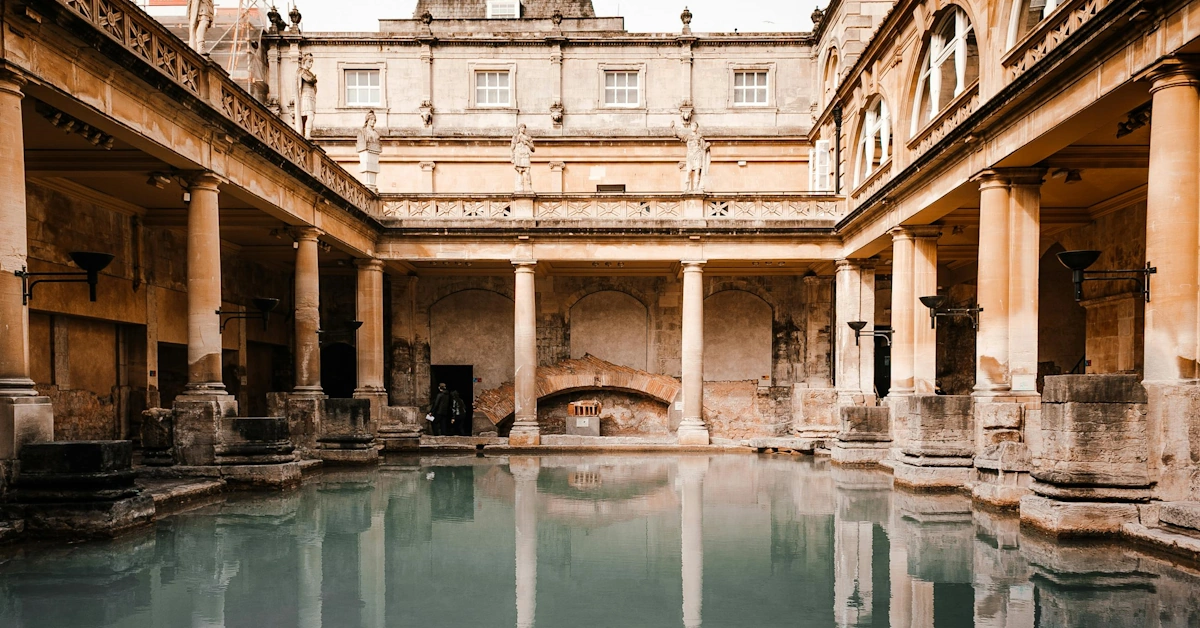
The Roman Baths offer arguably the most atmospheric and visually striking Roman footprint in the country. Standing beside the steaming green waters of the Great Bath, particularly during the torchlit evening hours, provides a powerful, immediate connection to the 1st century. The site seamlessly blends massive stone architecture with the healing, geothermal power of the naturally hot spring.
Comments from tourists include “It’s way bigger inside; give yourself 2+ hours.” and “You can taste the actual spa water at the end.” Tourists can not swin in the acient baths but you can in the exact same natural hot spring water right down the street at a modern facility called Thermae Bath Spa.
Beyond the Roman Baths, the ancient footprint of Aquae Sulis still dictates the layout of modern Bath if you know where to look. Take a stroll down vibrant Walcot Street, and you are actually walking the exact alignment of the Fosse Way—the bustling Roman highway and artisan district that once led weary travellers straight to the sacred springs. As with the Appian Way (Via Appia to the Romans) Roman tombs and stone carvings have been found close by on the Fosse Way because Roman law forbade burying the dead inside the city walls.
To gauge the scale of the ancient city, trace the route of the Upper Borough Walls; while the visible stonework is medieval, it sits directly atop the formidable 3rd-century Roman defensive perimeter that originally enclosed the resort. Even the city’s most iconic later landmarks hide classical secrets beneath their floors.
During recent excavations at Bath Abbey, archaeologists uncovered the eastern limits of the Roman bathing complex hidden in the dark earth for centuries. Today, you can head into the Abbey’s Discovery Centre and peer through a specially designed glass floor, looking directly down into the 2,000-year-old Roman heating systems and drains that once kept the ancient world’s premier tourist destination running.
Caerleon
Today, the town of Caerleon has largely been built over the ancient footprint, yet the exposed areas remain incredibly significant, and easy for people to visit. Visitors can walk the remains of the sprawling fortress, which once accommodated over five thousand legionaries, and stand within the atmospheric amphitheatre that hosted gladiatorial combat and military training exercises.
Caerleon Roman Fortress Baths provide a fascinating look at the daily lives of the military machine on the western frontier. Enclosed under a modern protective roof, the ruins allow you to clearly visualize the scale of the garrison’s leisure time, complete with interactive displays and striking lighting that highlights the ancient stonework.
The Caerleon amphitheatre remains one of the most complete in the United Kingdom, offering a clear layout of the seating banks (sufficient for 6000 people) and the central arena where immense spectacles took place. Walking through the surviving stone foundations of the barrack blocks, one can easily visualise the disciplined, cramped quarters where soldiers lived, ate, and slept alongside their comrades. This proximity to authentic military architecture makes it a prime destination for budget-friendly Roman ruin explorers seeking substantial historical value without extensive entrance fees. The site allows for extensive wandering, encouraging visitors to take their time absorbing the atmosphere of this once-mighty garrison.
Adjacent to the ruins, The National Roman Legion Museum houses a vast collection of artefacts excavated from the site, including intricate armour, weaponry, and personal items like engraved gemstones and currency. These exhibitions contextualise the physical ruins, illustrating the human element of the occupying forces who lived far from their Mediterranean origins. Taking part in Caerleon Roman Fortress tours often includes access to these detailed displays, bringing the overarching historical narrative into sharp focus for attendees of all ages. Educational programmes run frequently, ensuring the ancient history narrative is preserved and passed down.
Chedworth Roman Villa: Exploring one of the Best Roman Archaeological Sites
Discovered by a gamekeeper in the nineteenth century, this sprawling country estate offers a stark contrast to the military focus of Caerleon and the urban environment of Bath. Walking through the extensive ruins, one gains insight into the private lives of the elite class during the fourth century, an era often considered a golden age for Roman Britain. The sheer size of the property, complete with formal gardens and extensive outbuildings, suggests an agricultural estate that controlled vast swathes of the surrounding countryside. The construction techniques and materials used, including local limestone and imported marbles, reflect a sophisticated understanding of architecture and design. Visitors can traverse the perimeter of the main courtyard, visualising the grand facades that once greeted visiting dignitaries and high-ranking officials.
Transport Options from Bristol
Driving remains the most efficient method for reaching Caerleon and Chedworth, with the M4 motorway providing direct access into Wales, and the M5 leading straight towards the Cotswolds. For Bath, the train is heavily favoured; frequent services run directly from Bristol Temple Meads, dropping passengers just a short walk from the baths complex. This rail option avoids the complexities of city centre parking and perfectly suits those seeking stress-free transit. Incorporating these transport routes ensures your journey remains a pleasant part of the overall experience.
Where to Stay in Bristol: Quality, Comfort and Convenience
After a long day of exploring these fascinating historical sites, returning to a comfortable and well-equipped base is absolutely essential for a successful trip. For those seeking independence and domestic comforts during their travels, consider staying at Cherry View House, offering excellent value self catering accommodation in Bristol. Ideally situated at the centre of this trifecta of acient Roman historical exploration. Cherry View House provides the perfect environment to relax, review your photographs from the day, and prepare for your next excursion into the ancient past.